
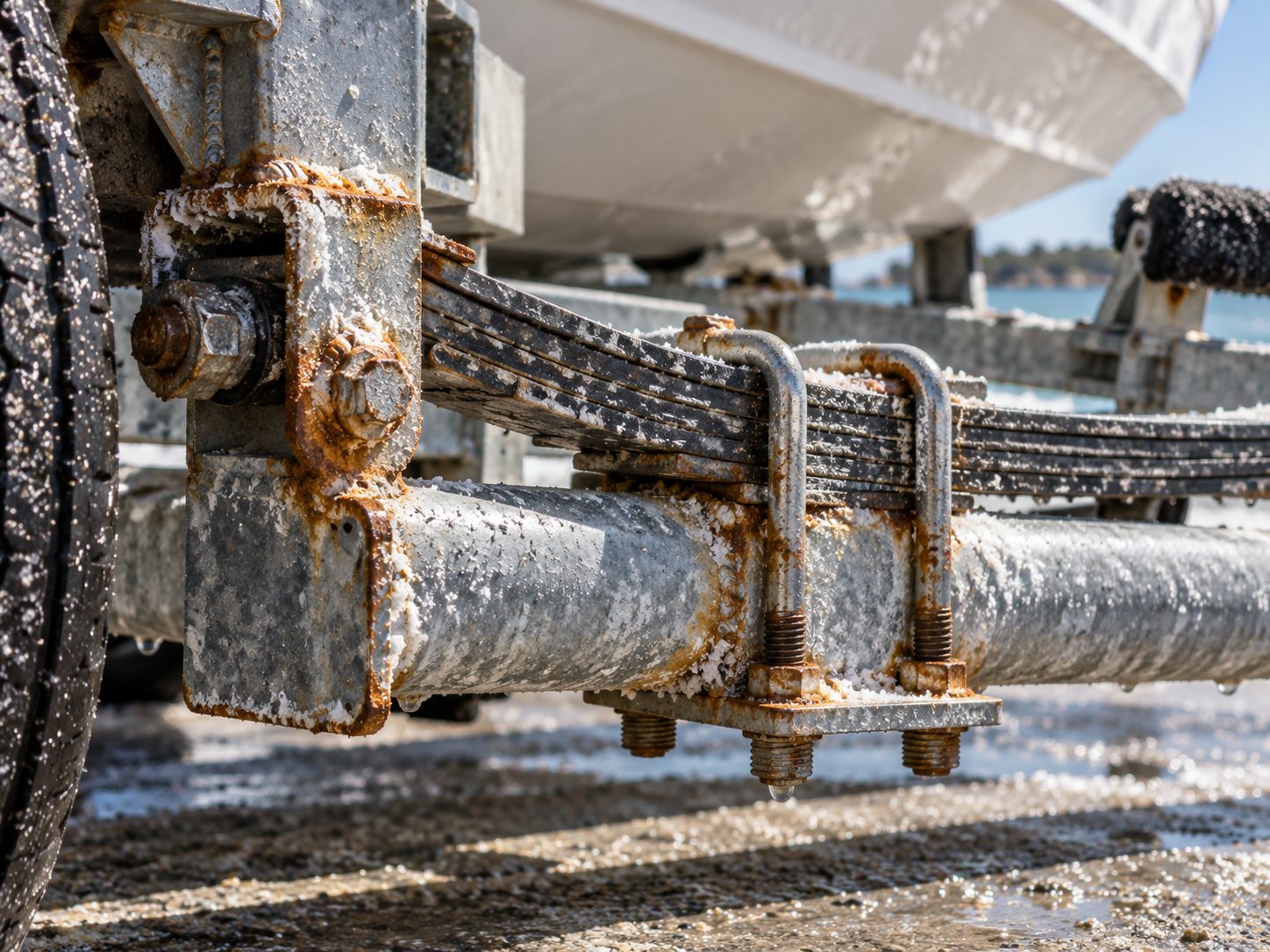
Salt air corrodes a boat trailer even if the trailer is never launched. Airborne chloride settles on the frame, draws moisture out of humid air, and starts rust at every chip, weld and bolt head. On the Carolina coast this happens year round, and it happens fastest to the parts you cannot see.
Most owners think of salt as a launching problem — back the trailer into the water, rinse it afterwards, job done. The launching is the obvious exposure. The one that quietly costs more is the trailer sitting still, three hundred yards from the waterway, for eight months.
How does salt reach a trailer that never gets wet?
Breaking waves throw sea water into the air as fine droplets. The water evaporates and leaves microscopic salt particles suspended in the wind, which carry inland and settle on every surface downwind. This is why cars near the coast rust faster than identical cars fifty miles away, and it is why a trailer parked in a driveway near the Intracoastal accumulates chloride without ever leaving the driveway.
Salt makes it worse in two distinct ways. It is hygroscopic, meaning it pulls water vapour out of the air, so a salted surface stays damp in humidity that would leave a clean surface dry. And dissolved chloride turns that film into an electrolyte, which lets the electrochemical reaction of rusting proceed far faster than plain water would allow.
Coastal Carolina supplies both halves generously: salt in the air and humidity most of the year.
Where does it start?
Not on the flat painted surfaces you look at. It starts where water sits and where the protective coating is already broken.
- Leaf springs and shackles. Layered steel with gaps that hold moisture, carrying the entire load. The single most common structural failure point on a coastal trailer.
- Brake lines and backing plates. Surface rust on a brake line is not cosmetic. A line that fails does so under load.
- Wiring and connectors. Corrosion travels up inside a wire from the connector. Lights that flicker are usually a corroded ground, and the ground is usually a bolt through the frame.
- Welds. The heat-affected zone either side of a weld is metallurgically different from the parent steel and often corrodes preferentially, which is why rust blooms in lines rather than patches.
- Inside the frame rails. Box-section steel that drains poorly holds water inside where you will never see it, and rusts outward.
- Wheel bearings. Salt-contaminated grease loses its protective quality. A seized bearing on the highway is a serious event.
Is galvanised or aluminium immune?
No. Better, not immune.
Hot-dip galvanising sacrifices a zinc layer to protect the steel underneath, which works well and works for years — but the zinc is consumed, faster in a chloride-rich environment, and once it is gone at a given spot the steel beneath is bare. Aluminium does not rust, but it does corrode, and it suffers galvanic corrosion where it meets dissimilar metals. On an aluminium trailer, watch the steel fasteners, the axles and the bunk brackets.
Does storing it inland actually help?
Yes, and the mechanism is simple: airborne salt concentration falls with distance from the surf. The heaviest deposition is in the first few hundred yards of the shoreline and it drops off sharply from there. A trailer stored well inland is accumulating a fraction of the chloride that the same trailer accumulates parked near the waterway.
It is not a magic fix. A trailer that gets launched in salt water still needs rinsing, and one already carrying rust will continue to carry it. What inland storage changes is the eight or nine months of the year when the trailer is doing nothing but sitting — and for most owners that is the majority of its life.
Our lot is on Swamp Fox Highway in Tabor City, off the coastal strip, which is why we talk about inland storage as preservation rather than just parking. See how boat storage works here.
What can you actually do about it?
- Rinse properly, not quickly. A pass with a hose over the top does little. Get underneath: springs, axle, brake components, inside the frame rails where you can reach.
- Let it dry before you park it. A trailer put away wet is a trailer left damp for a week.
- Grease the bearings on a schedule, not when they start making noise.
- Touch up chips immediately. Every scratch through the coating is where the next rust starts. Cold galvanising compound on bare steel is cheap.
- Spray a corrosion inhibitor on springs, fasteners and connectors before a long period of storage.
- Protect the connectors. Dielectric grease in the plug and on the ground bolt prevents most trailer light faults.
- Get it off the coast when it is not in use. The cheapest maintenance is reduced exposure.
Common questions
How quickly does salt-air corrosion actually show?
It depends on distance from the surf, prevailing wind, coating condition and how often the trailer is launched, so nobody can give you a figure that means anything for your specific trailer. What is consistent is the pattern: it starts at welds, fasteners and spring packs, and it is well advanced there before anything shows on the flat surfaces you look at.
Should I cover the trailer?
Cover the boat, be careful covering the trailer. A cover that traps moisture against steel and does not breathe can hold damp air around the frame and make things worse. Airflow underneath matters more than a sheet over the top.
Is an enclosed unit better than an open space?
For a boat on a trailer, most people take open ground — it is $75 a month here and it fits any length. Our enclosed 10 × 10 units at $95 suit the gear rather than the boat: outboard spares, electronics, safety equipment, anything you would rather not leave outdoors through a Carolina summer.
The short version
Salt reaches the trailer whether or not the trailer reaches the water. Rinse underneath, fix chips as they happen, grease the bearings, and reduce the months of exposure by keeping it inland when it is not being used.
We store boats on trailers on an open, gated lot off the coastal strip in Tabor City. Ask what is open or call (910) 377-2429.